
Thornback Fishing with John Locker
Though spring may mark the arrival of many migratory birds and insects, it heralds few notable changes in Britain’s marine environments, especially though the eyes of us anglers. The result of the sea taking longer to succumb to the effects of increased daylight hours and supposed better weather; not something that appears to be happening this year. In the Northeast, the Cod bounty of the winter season has long since ended and the summer fishing season, though tantalisingly close, isn’t yet upon us. Therefore, for any anglers hoping for a decent fishing session the best option is to travel. The Thornback Fishing on the northwest coast happens to present opportunities for the angler willing to make the journey, with small tides coinciding with a settled forecast, myself and John Locker decided to do just this.
Thornback Rays are present in good numbers in the Solway Firth throughout spring and with few other prospects of locating substantially sized species to target, anglers from around the north flood in to target them. They are present all along the Cumbrian and Dumfries and Galloway coastlines. Good bags can be caught from marks that allow anglers to present baits onto the soft sediments of this massive estuary.
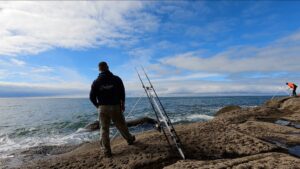
We timed our arrival for the start of the ebb, doing this enabled us to target fish passing through on the tide, we were met with a fine drizzle and blustery conditions. Not the nicest for a march through the sodden fields and down the steep Cumbrian cliffs. Once we’d descended onto the mark and chosen our spots it was time for business.
First rod out, straight squid mounted on a Pulley Pennel Rig armed with Cox & Rawle SCR29 Specimen Extras in 2/0, this pattern is ideal for Thornback Fishing offering a wide gape and strong construction in a compact hook. The second rod was armed with the same rig, however I opted for a mackerel and squid cocktail bait. Bait selection wise, we each had a similar, classic selection comprising of squid, mackerel and blacks. Having fished the mark a couple of times, certain baits have clearly out fished others on occasion, for instance straight squid can be a killer bait yet the following trip, the fish are honed in and feeding on small fish baits. Initially indications were that it was to be a slow session, with myself and John only managing a couple of dogfish in the first few hours of the ebb. However just before slack water a long steady pull registered on the tip before springing back slack line, a classic ray bite. Tightening down to a solid sensation, rhythmic wing beats were being transmitted through the braid, finally we were into our first ray. Sliding the fish into a pool, I looked up to see if John had noticed the capture, I was pleased to see him babbling away to the camera holding a ray he’d just caught himself. Hopefully this was a sign they were coming on the feed. Unclipping the rig and resting the fish in a pool, allows the fish to rest and me to get another bait out in the meantime, capitalising on the session. The Cox & Rawle Coast Lock clips are perfect for this, they offer a quick and easy clip yet a super strong hold.
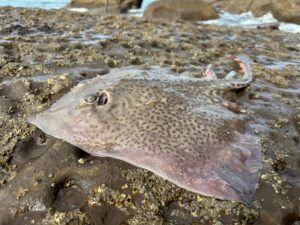
Though John managed to land another ray and dogfish in quick succession, the hectic flurry of fish I’d hoped for didn’t happen. This remained the story for the rest of the session with a steady trickle of fish. Longer snoods were tried, smaller baits, different rig styles, nothing really appeared to change the situation. As high water approached we’d each had a handful of rays and the ever present dogfish, it was discussed we’d call it a day within the hour. Between myself and John there’s always friendly competition, he’d had a few more rays than me so I opted to try and win the species battle. A 2 hook clip down was armed with small sections of blacks in the hope of a flatfish. Thankfully an obliging Dab clicked my species count up to three, I don’t think I’ve ever been so pleased with the simplest of species. That marked the end of the day, John won the main event on the rays, I took the belated species.
Now all that was left was the grueling ascent and a march back to the van, offering ample time to discuss the session and our next exploits. One thing we both noted, something that’s not unusual when ray fishing, is that most of the rays were hooked on the top hook of the Pennel Rig despite the choice of hook. I had used both SCR29 Specimen Extras and SCR32 Chinu patterns as my Pennel whilst John had also implemented circles. This is something I also see when Cod fishing in winter, I put it down to the feeding habits of these species. They’re suction feeders; therefore they typically inhale the full bait when feeding. I suspect that they’re regularly hooked in the Pennel hook as this would typically be the first point of contact with the fish’s mouth when the line is tightened. This differs from species such as bream or wrasse that will ‘pluck’ at baits and are therefore equally likely to be hooked on either hook. An increasing number of anglers are opting to use rigs such as the dongle when targeting suction feeding species, completely removing the lower hook.
You can find the full video of the session along with rig and baiting explanations over on the Fish Locker YouTube channel.
Until the next adventure, tight lines,
Tom Rowe
Recent Comments